There is a moment that many of our patients describe to us during their very first consultation. It is the moment they saw an advertisement usually online promising a full set of new teeth in a single day. Four implants. One appointment. A brand-new smile before dinner.
And they felt something complicated. Hope, certainly. But also doubt. Because something about the promise felt too neat, too fast, too good to be entirely true.
They were right to feel that way. Not because All-on-4 dental implants are not real or not effective, they absolutely are, and we at Aesthete Lifestyle Dentistry place them regularly at our clinics in HSR Layout and Residency Road. But because the way this procedure is marketed across Bangalore often leaves out the very details that determine whether it succeeds or fails.
This post is our attempt to fill those gaps. To tell you what All-on-4 dental implants actually involve, who they work best for, what happens when the process is rushed, and what it looks like when it is done with the care it genuinely demands.
What Exactly Are All-on-4 Dental Implants?
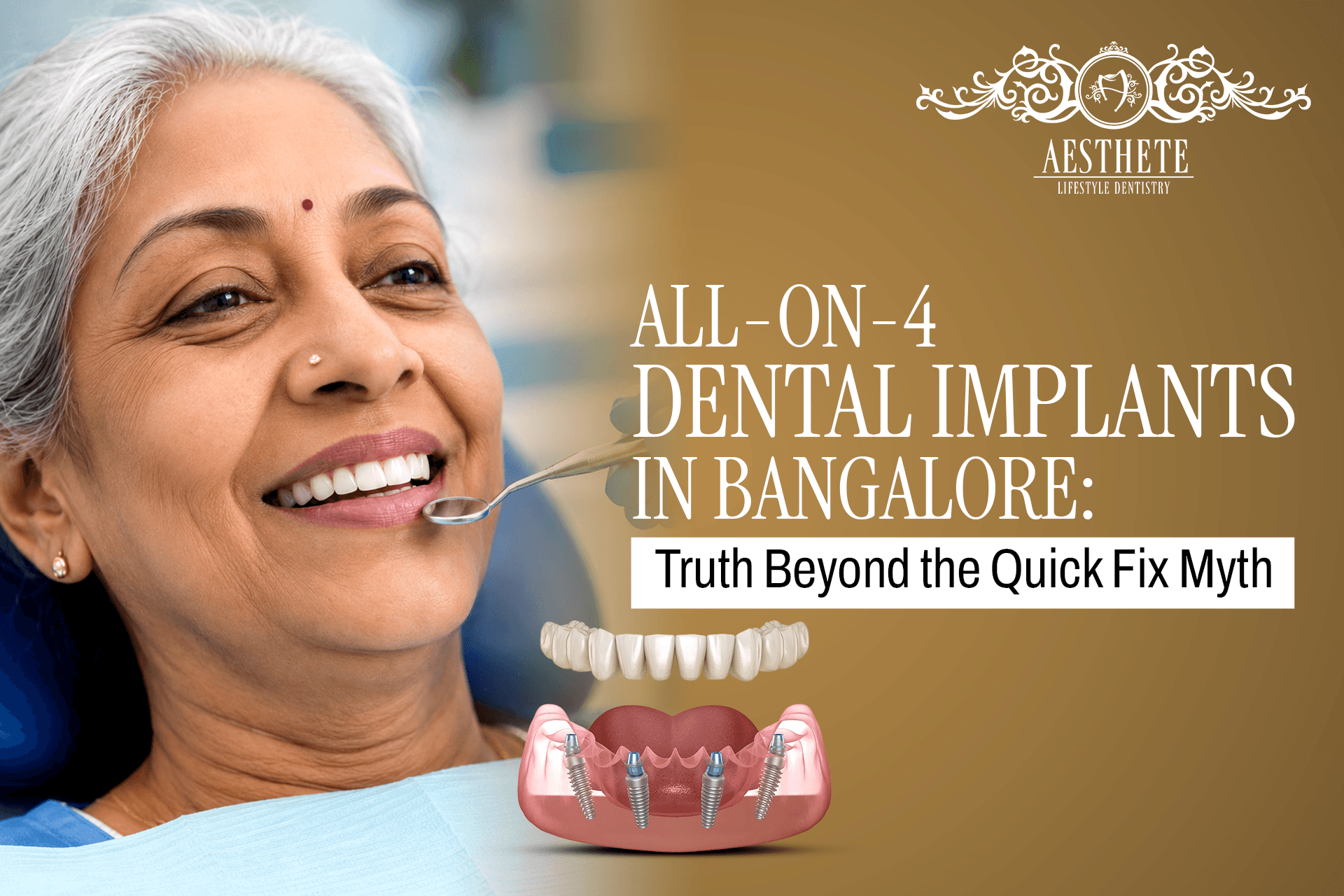
The concept is elegant in its simplicity. Instead of replacing each missing tooth with an individual implant which can mean six, eight, or even more implants per jaw — the All-on-4 technique uses just four strategically placed titanium implants to support an entire arch of fixed teeth.
Two implants go in vertically at the front of the jaw, where bone is naturally thicker. Two more are placed at an angle typically tilted up to 45 degrees — toward the back. This angulation is the real innovation. It allows the posterior implants to grip a larger surface area of existing bone, which often eliminates the need for bone grafting entirely.
The result is a full set of 10 to 14 prosthetic teeth, permanently fixed to the jaw, that look, feel, and function remarkably like natural teeth.
How This Differs from Conventional Implants
In a traditional full-arch implant approach, you might need six to eight implants per jaw, and if bone loss is significant — which it often is for patients who have been without teeth for years — procedures like bone grafts and sinus lifts may be required before a single implant can be placed. That adds months and considerable expense to the timeline.
All-on-4 was designed to work with the bone you already have. For many of the patients we see in Bangalore, people who have delayed treatment for years or decades, this is the difference between being told “you don’t have enough bone” and being told “we can work with what’s here.”
The “Quick Fix” Narrative: What It Gets Wrong
Let’s address the elephant in the room. The phrase “teeth in a day” has become the headline of nearly every All-on-4 advertisement in the city. And we understand why — it’s a compelling promise. But it is also an incomplete one, and incomplete promises in healthcare can be genuinely dangerous.
What “Teeth in a Day” Actually Means
Here is what happens on the day of surgery: the four implants are placed, and if they achieve sufficient primary stability (which we measure precisely in Newton-centimetres of torque), a provisional set of teeth is attached before you leave the clinic.
That word provisional is the part the advertisements tend to whisper rather than speak aloud.
The teeth you walk out with on day one are temporary. They are lighter, simpler, and intentionally designed to put less pressure on the implants while they heal. Over the next three to six months, the titanium implants undergo osseointegration — the biological process of fusing with your jawbone. Only after that process is complete do we fabricate and fit the final, permanent prosthesis.
So yes, you do leave with teeth on the same day. But the full journey takes months, involves multiple visits, and requires patience.
What Happens When Speed Becomes the Priority
We have seen and repaired the consequences of rushed All-on-4 procedures. Patients who come to us after treatment elsewhere, sometimes in visible distress, with stories that share a common thread: it all happened so fast.
The consequences of cutting corners in All-on-4 treatment are not trivial. Implants placed without adequate diagnostic imaging can miss the mark on positioning, leading to nerve damage, sinus perforation, or simply poor angulation that compromises long-term stability. Insufficient primary stability on the day of surgery can lead to early implant failure. A poorly designed provisional prosthesis can cause gum irritation, bite problems, and difficulty eating. And infections — born from rushed surgical protocols or inadequate sterilisation — can turn a hopeful experience into a deeply traumatic one.
None of this is meant to frighten you. It is meant to arm you with the truth so you can make a decision that protects you.
Who Is an Ideal Candidate for All-on-4 Implants?
One of the most important things we do during a first consultation is listen carefully and then tell the truth, even when it is not what a patient expects to hear. Not everyone who wants All-on-4 implants should receive them.
The Patients It Works Beautifully For
All-on-4 tends to be an excellent option for people who have lost most or all of their teeth in one or both jaws. It is also well suited for patients who currently wear full dentures and are exhausted by the daily frustrations — the adhesive paste, the slipping, the inability to eat freely. Patients with moderate bone loss who want to avoid extensive grafting procedures are often ideal candidates, as are individuals in overall good health with no uncontrolled systemic conditions.
When We Recommend a Different Path
Some patients need a different approach, and recommending that different approach is not a failure. It is responsible care.
Patients with severe, uncontrolled diabetes face higher risks of implant failure due to impaired healing. Heavy smoking significantly compromises osseointegration. Active periodontal disease must be treated and stabilised before any implant can be placed. And in cases of very advanced bone loss - where even angled implants cannot find sufficient purchase we may explore zygomatic implants, which anchor into the cheekbone, or design a staged treatment plan that rebuilds the foundation before placing the implants.
This is where having a multidisciplinary team matters enormously. At our clinics, our prosthodontist, periodontist, endodontists, and orthodontist all contribute to the evaluation. A case does not move forward until every specialist is confident in the plan. That is not bureaucracy. That is safety.
What a Thorough All-on-4 Process Looks Like at Our Practice
We want to walk you through what actually happens when you choose this treatment with us. Not to impress, but to set honest expectations. Because we have found that patients who understand the process trust the process — and trust makes everything easier.
Comprehensive Diagnosis and Planning
This is the stage that separates a thoughtful practice from a hurried one, and it is the stage most often abbreviated by clinics chasing the “same-day” narrative.
Before we make any surgical decision, we conduct a full clinical examination of your mouth, gums, and existing teeth (if any remain). We take 3D cone beam computed tomography (CBCT) scans, not basic X-rays to evaluate bone volume, bone density, and the precise location of anatomical structures like the inferior alveolar nerve and the maxillary sinus. We review your complete medical history, including medications, chronic conditions, and surgical history. We take digital impressions and, where appropriate, use digital smile design to preview the aesthetic outcome before a single incision is made.
This planning phase takes time. It is supposed to. When someone offers to skip it, they are not doing you a favour.
Implant Placement Surgery
On the day of surgery, the four implants are placed under local anaesthesia (or sedation, depending on your preference and clinical needs). The two front implants are positioned vertically. The two posterior implants are tilted to engage maximum bone and avoid critical structures. Every implant is tested for primary stability.
This is precision work. Millimetres matter. The angle matters. The torque matters. And the experience of the surgeon placing them matters perhaps most of all.
The Provisional Prosthesis
If stability readings confirm that the implants can support immediate loading, a pre-fabricated provisional prosthesis is attached that same day. This gives you functional teeth to leave with — teeth that allow you to speak, smile, and eat a soft diet while healing progresses.
The provisional prosthesis is not your final smile. Think of it as the scaffolding that keeps everything stable while the real structure sets.
Healing and Osseointegration
Over the next three to six months, biology does its work. The titanium implants gradually fuse with the living bone around them, forming a bond that is remarkably strong and durable. During this period, you follow a modified diet (nothing too hard or chewy), attend regular follow-up appointments with us, and take care of your oral hygiene with the tools and guidance we provide.
This is not a passive phase. We monitor your healing closely, checking for any early signs of complications and adjusting care as needed.
The Final Prosthesis
Once osseointegration is confirmed through both clinical and radiographic evaluation, we fabricate your permanent prosthesis. This is a custom-crafted, high-strength restoration — often made from zirconia or premium acrylic over a titanium framework — designed not just to function perfectly, but to complement your facial features, skin tone, and natural smile aesthetics.
This is where the artistry in our name comes alive. Aesthete is not just a word on our signboard. It is a standard we hold ourselves to with every prosthesis we design.
What Makes a Premium All-on-4 Experience Different?
Bangalore has many clinics offering All-on-4 implants. The price range is vast, and so is the quality. We believe patients deserve to understand what they are actually paying for — and what they are risking when they choose the lowest bid.
Technology That Changes Outcomes
We use CBCT imaging for three-dimensional treatment planning because a standard X-ray cannot show you what you need to see. We use guided surgery systems — digitally designed surgical templates — that translate our plan into millimetre-precise execution. We use digital impression systems because accuracy at this stage determines how well your prosthesis fits. And we use CAD/CAM fabrication because the prosthesis that sits in your mouth every day for the next 15 to 20 years deserves to be milled with precision, not estimated by hand.
These are not premium extras. They are the standard of care when you are placing permanent hardware into someone’s jaw.
An Experienced & Expert Team
All-on-4 implants sits at the crossroads of surgical skill, prosthetic design, periodontal health, and sometimes orthodontic alignment. No single dentist, however talented, can master all of these domains simultaneously. That is why our team includes Dr. Mitha Shetty (Prosthodontist), Dr. Geetha Priyadharshni (Periodontist), Dr. Ashish Shetty and Dr. N. Rajeeva Shetty (Endodontists), Dr. Akshai Shetty (Orthodontist), and Dr. Kavitha Rai (Pedodontist). Each case is reviewed collaboratively so that the plan you receive has been stress-tested from every clinical angle.
Materials That Last
We have seen patients arrive from other clinics with prostheses made from lower-grade materials that looked acceptable for the first year but then began to chip, discolour, or warp. The implant systems we use are backed by decades of published clinical research and long-term survival data. The prosthetic materials we choose resist wear and staining. And every restoration is designed to age gracefully, not just look good on the day of fitting.
All-on-4 Dental Implants Cost in Bangalore
We know that cost is a significant factor, and we respect that. The price for a single-jaw All-on-4 restoration in Bangalore varies widely, and the reasons for that variation are worth understanding.
The cost depends on the implant brand and system used, the type of prosthetic material selected (zirconia, acrylic, hybrid), whether supplementary procedures like extractions, gum treatment, or minor bone grafting are needed, and the level of diagnostic technology, clinical expertise, and follow-up care included in the treatment.
We do not publish prices here because every patient’s case is genuinely different, and quoting a number without a proper evaluation would be the same kind of oversimplification this entire post argues against. What we do offer is complete transparency after your consultation — a detailed breakdown of every cost involved, with no surprises — along with flexible payment options that ensure the financial aspect never forces a compromise in the quality of your care.
The only thing we will say about pricing is this: a failed implant or a poorly made prosthesis will always cost more to repair than doing it right the first time. Always.
Living with All-on-4 Implants: What to Expect Long-Term
One of the questions patients ask least during their research but should ask most is this: what happens after the treatment is done?
Daily Care
Caring for your All-on-4 restoration is straightforward but non-negotiable. You brush with a soft-bristled toothbrush, clean beneath the prosthesis using a water flosser or specialised floss threaders (because plaque can still accumulate where the prosthesis meets your gums), and rinse with an antimicrobial mouthwash as we recommend.
It is simpler than caring for natural teeth with interdental gaps, but it does require consistency. The implants themselves cannot decay, but the gum tissue and bone around them can still become inflamed if oral hygiene is neglected — a condition called peri-implantitis.
Professional Maintenance
We recommend a professional cleaning and implant check every six months. During these visits, the prosthesis may be temporarily removed so we can clean areas that are impossible to reach at home, and we examine the implants and surrounding bone for any early signs of concern.
Think of it the same way you think about servicing a well-built car. The engineering is excellent, but it still benefits from regular attention.
How Long Do They Last?
With proper care, the titanium implants themselves can last a lifetime. The prosthetic teeth depending on the material and your habits — typically serve you well for 15 to 20 years before needing replacement or refurbishment. Starting with a high-quality prosthesis and maintaining it carefully is the simplest way to maximise its lifespan.
Common Myths We Hear from Patients and the Truth Behind Them
I’ll get my permanent teeth in one day.
You will get functional, provisional teeth on the day of surgery. Your permanent prosthesis is fabricated months later, after your implants have fully integrated with the bone. Both stages matter. Skipping one compromises the other.
Anyone can get All-on-4 implants.
A proper clinical evaluation is essential. Certain medical conditions, habits like heavy smoking, or the extent of bone loss may mean a different approach is more appropriate for you. A good implant team will tell you this upfront, not after a complication.
It’s the cheapest way to replace all my teeth.
While All-on-4 requires fewer implants than a traditional full-arch restoration, it is not a budget procedure. The surgery, prosthesis, technology, and ongoing care involved make it a serious investment. What it offers in return — comfort, function, confidence, and longevity makes it an investment that pays dividends for decades.
“All clinics deliver the same results.”
This is the myth we wish more patients would question. The skill of the surgeon, the quality of the implant system, the precision of the prosthesis, and the diligence of follow-up care vary enormously. Choosing the wrong provider can lead to complications that cost far more financially and physically than the original procedure.
Why Our Patients Trust Us with This Procedure
We are not the cheapest All-on-4 option in Bangalore. We have never tried to be, and we never will.
What we are is a practice built across three generations of dental care, where every treatment plan is designed by a team of specialists rather than a single practitioner. Where a five-star philosophy excellence in every detail, patient-centred care, integrity and transparency, a calm environment, and elevated comfort is not a marketing line but a daily discipline.
We are a practice where no one will rush your treatment to fit a marketing promise. Where you will never be told what you want to hear at the expense of what you need to know. And where the result we aim for is not just a smile that looks good on the day of fitting, but one that serves you comfortably and confidently for years to come.
If you have been considering All-on-4 dental implants, we would welcome the chance to have an honest conversation with you about whether it is the right path for your specific situation. No pressure. No overselling. Just clarity.
FAQs – All-on-4 Dental Implants in Bangalore
1. Are All-on-4 dental implants really completed in one day?
Not entirely. While patients usually receive a temporary fixed set of teeth on the same day as the implant surgery, the final permanent prosthesis is placed only after the implants fully heal and integrate with the jawbone. This healing process typically takes 3 to 6 months.
2. Who is the ideal candidate for All-on-4 dental implants?
All-on-4 implants are best suited for people who have lost most or all of their teeth, wear uncomfortable dentures, or want a fixed full-mouth restoration without extensive bone grafting. A detailed clinical evaluation is necessary to determine suitability based on bone health, medical conditions, and lifestyle habits like smoking.
3. How long do All-on-4 dental implants last?
With proper oral hygiene and regular dental maintenance, the titanium implants themselves can potentially last a lifetime. The prosthetic teeth generally last around 15 to 20 years before they may need repair or replacement depending on wear and maintenance.
4. Is the All-on-4 procedure painful?
The procedure is typically performed under local anaesthesia or sedation, making it comfortable for most patients. Mild swelling or discomfort after surgery is normal and usually manageable with prescribed medications and post-operative care instructions.
5. Why do All-on-4 implant costs vary between clinics in Bangalore?
The cost depends on several factors including the implant brand, prosthetic material used, diagnostic technology, surgeon expertise, and whether additional procedures are required. Clinics offering lower prices may compromise on materials, planning, or follow-up care, which can affect long-term success.
Book Your Consultation
Call us at 080-2550-4231
Visit our clinic at HSR Layout or Residency Road, Bangalore
Or book your appointments online: